
If you are searching for the latest tech news and upcoming technology trends, the technological landscape spanning late 2026 through 2027 represents a profound inflection point across multiple disciplines. This era is characterized by the convergence of agentic artificial intelligence, the maturation of sub-3-nanometer semiconductor manufacturing, and a fundamental restructuring of consumer electronics and enterprise hardware ecosystems. The era of iterative, isolated hardware updates is ending, replaced by a paradigm where operating systems, silicon architectures, and multi-modal AI models are developed as cohesive, highly integrated stacks. This exhaustive analysis for thedailynote.blog synthesizes current supply chain data, engineering leaks, and corporate roadmaps to provide a comprehensive forecast of the future of AI, next-generation computing, smartphones, robotics, and energy storage sectors over the next twenty-four months.
Industry Showcases: The 2026–2027 Tech Events Roadmap

Before analyzing the underlying technologies, it is essential to contextualize the timeline of their introduction. The technology industry relies on a structured tech events calendar of conferences and symposiums to unveil both consumer products and enterprise infrastructure. The late 2026 and early 2027 calendar highlights a heavy emphasis on cloud computing, consumer electronics, and system design. Major announcements regarding generative AI and cloud infrastructure are anticipated at AWS re:Invent in late 2026, while CES 2027 remains the paramount proving ground for consumer hardware and automotive breakthroughs. Simultaneously, highly specialized events like USENIX SREcon and FAST ’27 will dictate the underlying storage and networking architectures that support these consumer advancements.
| Event Name | Expected Dates | Core Technological Focus |
| AWS re:Invent | Nov 30 – Dec 4, 2026 | Cloud Infrastructure, Generative AI |
| CES 2027 | Jan 6 – 9, 2027 | Breakthrough Consumer Electronics, Automotive |
| USENIX FAST ’27 | Feb 23 – 25, 2027 | File and Storage Technologies |
| CTA Tech Week | Apr 21 – 22, 2026 | Tech Policy, Digital Patriots Innovation |
| USENIX NSDI ’27 | Apr 12 – 14, 2027 | Networked Systems Design and Implementation |
The Upcoming Smartphone Ecosystem: Silicon Refinement and Market Stratification
For those tracking the latest smartphone leaks, the global mobile market is undergoing a strategic bifurcation. Original Equipment Manufacturers (OEMs) are increasingly decoupling their high-end premium models from standard base variants, both in terms of feature sets and release schedules. This shift is primarily driven by the soaring costs of advanced silicon nodes and the requisite hardware configurations necessary to run heavy, on-device artificial intelligence tasks efficiently.
Apple’s Fractured Release Cadence and the Foldable iPhone Dilemma
Apple is undertaking one of the most complex product cycle restructurings in its history to manage component costs and maximize early-adopter revenue. Tracking the iPhone 18 release date rumors, historically reliant on unified September launch events, the company is projected to stagger the release of its iPhone 18 series. The premium iPhone 18 Pro and iPhone 18 Pro Max models are slated for release in September 2026, while the standard base iPhone 18—which rumors suggest will see virtually no exterior design changes—is expected to be delayed until the spring of 2027. Despite abysmal sales of the ultra-thin iPhone Air, Apple supply chain leaks indicate the company will push forward with a second-generation “iPhone Air 2” to maintain its multi-tier strategy, potentially adding a 48-megapixel Fusion Ultra Wide second rear camera to address consumer criticisms.
The internal architecture of the iPhone 18 Pro series represents a significant leap forward in mobile technology. The devices will be powered by the A20 Pro chip, fabricated on a state-of-the-art 2-nanometer (2nm) process. This transition from the 3nm node will yield substantial improvements in both computational density and power efficiency, which is critical for supporting the continuous background processing required by Apple Intelligence features. Furthermore, Apple is expected to debut its proprietary C2 5G modem across the lineup, severing its long-standing reliance on Qualcomm. This vertical integration of the modem will likely result in enhanced battery life, as Apple can optimize power draw at the hardware level, while also potentially supporting advanced satellite internet capabilities beyond mere emergency use. Looking further ahead, Apple aims to deploy an A21 chip and entirely outperform Qualcomm modems in speed and AI functionality by the launch of the 20th Anniversary iPhone in 2027.
Aesthetically and functionally, the iPhone 18 Pro series will feature a refined front display. The highly visible Dynamic Island will be significantly reduced in size, achieved by moving the Face ID infrared sensor and flood illuminator beneath the display panel. The rear camera system on the Pro Max variant is anticipated to introduce a variable aperture, a sophisticated mechanical addition that allows for granular control over depth of field and low-light performance.
Simultaneously, Apple’s pursuit of a foldable form factor has encountered severe engineering friction. The highly anticipated “iPhone Fold” (or iPhone 18 Pro Max Fold) has reportedly faced complex development issues during its engineering verification test (EVT) phase. Suppliers have been notified of production schedule adjustments, pushing the earliest potential launch from late 2026 well into 2027. When it does arrive, dummy unit leaks suggest a wider, more squat design compared to traditional book-style foldables, potentially featuring a 5.5-inch outer display and a 7.8-inch inner display with an aspect ratio reminiscent of the iPad mini. It is also rumored to pack a massive 5,400 to 5,800mAh battery, becoming Apple’s most expensive and power-dense handset to date.
Samsung Galaxy S27 Rumour’s: A Strategic Pivot to a Four-Tier Flagship Line up
In the latest Samsung Galaxy news, the brand is radically altering its flagship strategy for the Galaxy S27 series, scheduled for an early 2027 release. For the past six generations, Samsung has adhered to a predictable three-tier structure: standard, Plus, and Ultra. The 2027 roadmap introduces a fourth model, the Galaxy S27 Pro.
The introduction of the Galaxy S27 Pro is a direct strategic response to Apple’s lineup structure and follows the complete market failure of Samsung’s previous attempt at a super-thin fourth model, the Galaxy S25 Edge. The S27 Pro is designed to offer the premium specifications of the Ultra tier—most notably the advanced 200MP camera system and the newly introduced Privacy Display—within a more compact, manageable form factor positioned between the Plus and the Ultra. Crucially, the S27 Pro will omit the S Pen stylus, serving as the primary differentiator between it and the top-tier Ultra model. This strategic shift acknowledges a distinct consumer demographic that desires uncompromised camera and display technology but is deterred by the physical bulk and specialized productivity features of the Ultra variant.
Google Pixel 11 Ecosystem: Hardware Maturation and Features
According to the latest Google Pixel 11 leaks, the series expected to launch in August 2026, demonstrates a maturation of Google’s hardware ambitions. The lineup will consist of four models, developed under bear-themed internal codenames: the standard Pixel 11 (‘cubs’), Pixel 11 Pro (‘grizzly’), Pixel 11 Pro XL (‘kodiak’), and the foldable Pixel 11 Pro Fold (‘yogi’).
The core of the Pixel 11 series is the custom Tensor G6 chipset. Following the thermal success of the Tensor G5, the G6 is expected to focus heavily on raw performance and advanced on-device AI processing capabilities. Google is also projected to reintroduce a dedicated 3D face recognition system, functionally similar to Apple’s Face ID, utilizing invisible sensors embedded beneath a 6.3-inch LTPO AMOLED display.
To support the heavy demands of local AI models, Google will establish 12GB of RAM as the baseline across the series, abandoning the inadequate 128GB storage tier in favour of a 256GB starting point, supported by a 5,000mAh battery. The Pixel 11 Pro Fold is also heavily rumoured to feature a slimmer profile and potentially a removable battery, signalling a broader industry shift toward sustainable and repairable electronics.
| Feature Metric | Apple iPhone 18 Pro | Samsung Galaxy S27 Pro | Google Pixel 11 Pro |
| Launch Timeline | September 2026 | Early 2027 | August 2026 |
| Core Processor | A20 Pro (2nm) | Unconfirmed Snapdragon/Exynos | Tensor G6 |
| Display Technology | Small Dynamic Island / Under-display Face ID | Privacy Display Integration | 6.3-inch OLED, Under-display 3D Face Scan |
| Key Camera Spec | Variable Aperture (Pro Max) | 200MP Main Sensor | 50MP Wide, 48MP Ultrawide, 48MP Telephoto |
| Hardware Omissions | No physical SIM (eSIM only on Fold) | No S Pen integration | Discontinuation of 128GB tier |
Operating Systems and the Integration of Agentic AI

Operating systems are undergoing a philosophical transformation driven by the future of AI integration. Historically, an OS acted as a passive platform for launching discrete applications. Moving into 2026 and 2027, the OS acts as an active, agentic layer that orchestrates tasks across applications using system-wide artificial intelligence.
Apple’s iOS 26 and iOS 27: Rebuilding Developer Trust
Apple’s software ecosystem is at a critical juncture. Based on the newest iOS 26 rumors, the Worldwide Developers Conference (WWDC) in June 2026 is viewed by analysts as a vital moment for the company to deliver on unfulfilled AI promises from previous years. Historically, Apple announced ambitious “Apple Intelligence” features that ultimately devolved into vaporware, severely damaging trust among third-party developers who rely on stable APIs to build their software.
iOS 26 is expected to introduce a comprehensive visual overhaul crafted with “Liquid Glass”—a new translucent material that reflects and refracts digital surroundings to create a more dynamic user interface. More importantly, the update embeds AI deeply into the system architecture. Features include real-time live translation across FaceTime and Phone apps, AI-powered generation of Shortcut actions, Genmoji integration, and systemic visual intelligence capable of analyzing screenshots for actionable data. Furthermore, Apple Wallet will leverage AI to extract order tracking information directly from emails without requiring merchant participation.
However, Apple’s systemic reliance on external models, such as Google’s Gemini, as a foundational layer for certain tasks highlights a vulnerability in Apple’s proprietary LLM development. By the time iOS 27 launches in 2027, the industry anticipates Apple will have fully transitioned to its internal, on-device models to preserve its rigid privacy standards and power its upcoming hardware ecosystem.
Android 17 Features: Desktop-Class Multitasking and Agentic Systems
Google’s Android 17 release, projected for a Q2 2026 debut following extensive Beta testing, represents a fundamental shift in mobile productivity. The OS introduces “App Bubbles,” a radical new multitasking paradigm that allows applications to float and interact over others, moving Android closer to a desktop-class windowing environment.
Furthermore, Android 17 pioneers the deployment of “Agent-style” AI assistants. Unlike traditional voice assistants that merely retrieve information or toggle settings, these AI agents possess the semantic understanding and API access necessary to autonomously operate third-party applications on the user’s behalf. The update also brings stringent security upgrades, including temporary contact pickers, advanced protection against malicious networks, and native App Lock capabilities—a feature historically reliant on third-party OEM skins. For media creators, Android 17 introduces RAW14 image format support, customizable Photo Picker aspect ratios, and the extended HE-AAC software encoder for superior audio at low bandwidths.
The Windows 12 Hallucination and Microsoft’s True Trajectory
The tech industry recently experienced a widespread, AI-driven misinformation loop regarding the Windows 12 release date. Prominent rumors circulated claiming that Microsoft would launch a mandatory subscription-based, strictly AI-focused “Windows 12” in 2026. Detailed analysis reveals that these rumors were largely “AI hallucinations”—fabricated narratives generated by Large Language Models scraping outdated concepts like “CorePC”, which were then reported as fact by automated tech blogs, creating a self-reinforcing loop of misinformation across social media platforms.
The reality of Microsoft’s roadmap is far more grounded. Microsoft remains committed to its “Windows as a Service” paradigm. The internal codename “Hudson Valley,” often erroneously attributed to Windows 12, was actually the identifier for the Windows 11 24H2 update. Moving forward, Microsoft is expected to release Windows 11 25H2, which will remain supported through October 2027.
If a true “Windows 12” materializes, it is highly likely targeted for a late 2027 release. It will not force a mandatory subscription on standard consumers, though business and enterprise “Pro” tiers may see heavier integration with Windows 365 Cloud PC subscription models. The defining feature of any subsequent Windows version will be an absolute requirement for a powerful Neural Processing Unit (NPU) to drive deep, OS-wide Co-pilot+ integrations.
| Operating System | Major Release Window | Core Architectural Focus | Key Features |
| Apple iOS 26 | Q3 2026 | On-device AI, Visual Refresh | Liquid Glass UI, Live Translation, Genmoji |
| Google Android 17 | Q2 2026 | Multitasking, App Control | App Bubbles, Agent-style AI, RAW14 Support |
| Microsoft Windows 12 | Late 2027 (Projected) | Deep Copilot+ Integration | NPU mandatory hardware, Pro-tier subscriptions |
The Artificial Intelligence Paradigm: Trillion-Parameter Architectures

The artificial intelligence sector in 2026 and 2027 is moving away from basic conversational models toward autonomous, multi-modal agents capable of complex reasoning, spatial understanding, and long-horizon task execution.
Frontier Models: Llama 4, Gemini 3.0, and OpenAI’s “Spud”
Meta’s Llama 4, expected in late 2025 to early 2026, represents the pinnacle of open-source AI. Training Llama 4 required a staggering ten times the computational resources of its predecessor. The model is architected explicitly for “agentic capabilities”—the ability to plan, autonomously execute code, browse the live web, and orchestrate external tools. By keeping Llama 4 open-source, Meta is democratizing access to enterprise-grade AI, allowing organizations to deploy and fine-tune agents locally without incurring exorbitant cloud API costs.
Google’s response, Gemini 3.0, introduces a paradigm shift in default behavior. Advanced reasoning is baked natively into the core model, eliminating the need for users to manually trigger specialized “thinking” modes. Gemini 3.0 boasts a multi-million token context window, dwarfing the 2 million token limit of Gemini 2.5. Its most profound advancement is in multi-modal spatial understanding; the model can process live video feeds at 60 frames per second and natively comprehend three-dimensional spatial relationships, making it an ideal neural backbone for augmented reality systems and advanced robotics.
Simultaneously, Open AI is navigating its transition to a publicly traded entity, with an IPO anticipated as early as late 2026. The company has ruthlessly reallocated computing resources—including shuttering the Sora video platform—to focus entirely on its next-generation language model, internally codenamed “Spud”, which is engineered for absolute enterprise productivity dominance. Early deployments, such as the GPT-5.4 variant released in early 2026, have already demonstrated capabilities that surpass human baselines in complex desktop productivity benchmarks.
Next-Generation Computing Architectures: The Silicon Battlefield
For PC builders and enterprise IT professionals tracking next-generation computing architectures, the hardware market is experiencing a period of intense architectural warfare. The focus has shifted from mere clock speeds to Instruction Per Clock (IPC) uplifts, unified memory architectures, and the integration of massive Neural Processing Units (NPUs) to support the software demands detailed above.
Apple’s Yield Economics and the MacBook Neo
Apple has achieved remarkable market penetration with its entry-level MacBook Neo. The device’s aggressive $599 starting price was achieved through an ingenious supply chain strategy: utilizing “binned” A18 Pro chips originally manufactured for the iPhone 16 Pro. By repurposing silicon with minor manufacturing defects (e.g., one non-functional GPU core), Apple bypassed the immense costs associated with fabricating entirely new M-series chips for low-margin devices. To maintain this price, Apple omitted premium features like a backlit keyboard and a Force Touch trackpad.
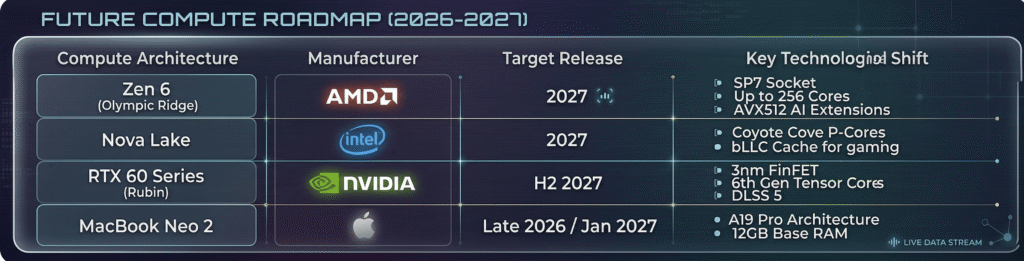
However, the unprecedented success of the MacBook Neo has exhausted Apple’s stockpile of A18 Pro chips, and the N3E manufacturing node at TSMC is entirely sold out. Consequently, Apple is accelerating the development of the MacBook Neo 2. Originally slated for March 2027, the Neo 2 may launch as early as late 2026 or January 2027. It will transition to the A19 Pro architecture—shared with the upcoming iPhone 17 Pro—and establish 12GB of RAM as the new baseline, a necessary upgrade for the memory-intensive tasks dictated by Apple Intelligence.
The x86 Desktop Wars: AMD Zen 6 versus Intel Nova Lake
The desktop processor market is bracing for a monumental clash between AMD’s Zen 6 architecture (codenamed “Olympic Ridge”) and Intel’s Nova Lake. Both architectures are targeted for release in 2027, reflecting extended development cycles necessitated by the complexity of modern semiconductor design.
AMD’s Zen 6 will operate on the upcoming SP7 socket and feature profound improvements in memory bandwidth. Enterprise variants of Zen 6 are projected to scale up to an astonishing 256 cores, with each Core Complex Die (CCD) housing up to 12 cores. Crucially, Zen 6 will introduce robust new instruction extensions—including AVX512_BMM, AVX_VNNI_INT8, and AVX512_FP16—specifically designed to accelerate local AI inference and complex mathematical modeling, alongside support for FRED.
Conversely, Intel’s Nova Lake architecture is poised to mount a formidable challenge. Initial engineering leaks suggest that Nova Lake’s “Coyote Cove” Performance-cores (P-cores) may deliver a higher generation-on-generation IPC uplift than Zen 6, though Zen 6 may retain higher absolute clock speeds. Intel aims to pair this IPC advantage with massive Last Level Caches (bLLC), specifically engineered to neutralize AMD’s current gaming dominance achieved through its 3D V-Cache technology.
NVIDIA RTX 60 Series Roadmap Delay: Prioritizing the Enterprise
The consumer graphics card market is experiencing a deliberate deceleration. NVIDIA’s highly anticipated GeForce RTX 60 series, built upon the “Rubin” architecture, has been delayed and is now projected to enter mass production in the second half of 2027, with high-end models like the RTX 6090 utilizing GR20X silicon.
This delay is not rooted in engineering failure, but rather in macroeconomic prioritization. Global memory chip shortages, combined with insatiable enterprise demand for data center AI accelerators, have incentivized NVIDIA to deprioritize consumer silicon. Consumer GPUs yield significantly lower profit margins compared to enterprise AI hardware like the H300, prompting a reallocation of TSMC foundry capacity to the Vera Rubin enterprise platform.
When the RTX 60 series eventually launches, it will utilize a custom variant of TSMC’s 3nm FinFET node, breaking away from the sub-2nm nanosheet rush. The architecture will feature 6th Generation Tensor cores and 5th Generation RT cores. A primary design objective is to enable DLSS 5—an AI-driven neural rendering technology that generates in-game assets and lighting in real-time—to operate smoothly on a single GPU, moving away from the multi-GPU requirements seen in early technical demonstrations.
XR, Wearables, and EV Automotive Evolution

Beyond traditional computing, 2026 acts as a steady evolutionary year rather than an abrupt revolution for mixed reality and automotive tech. In the Extended Reality (XR) space, Meta has reportedly paused plans to push its Horizon OS broadly to third-party headsets, focusing instead on internal ecosystem polish. Meta’s highly anticipated “Phoenix” mixed reality glasses have been pushed from late 2026 into 2027, though developers may receive the “Orion” AR headsets earlier. Concurrently, Apple is exploring a lighter, more affordable Vision-style device, cementing 2026 as a year for practical, niche enterprise use and hands-free notifications rather than mass-market immersion.
In the automotive sector, 2026 is a massive model-year moment for Electric Vehicles (EVs). Automakers are utilizing 2026 to push comprehensive upgrades, demonstrated by the heavily tested 2026 Subaru Solterra refresh, which signifies a broader industry wave of mass-market and premium EV releases focused on performance efficiency.
The Robotics and Automation Inflection Point
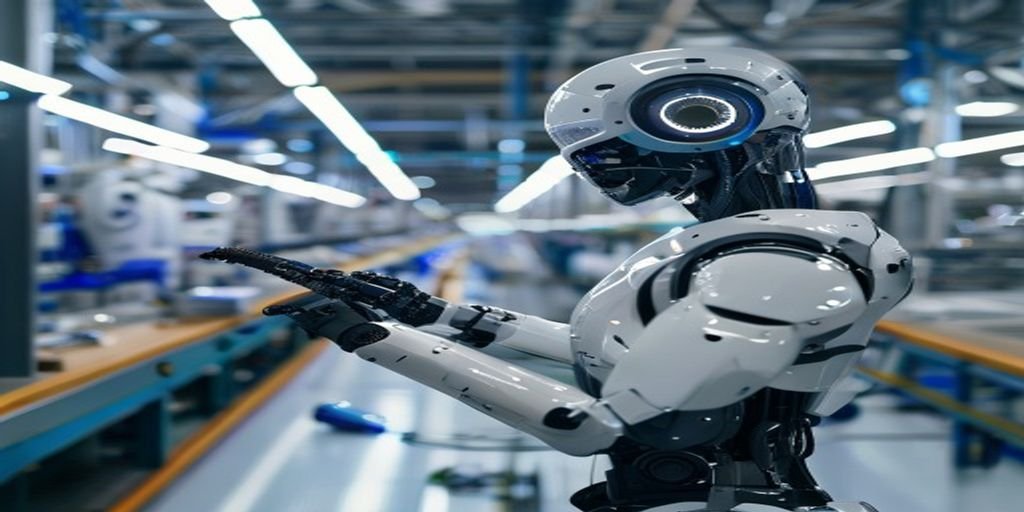
The culmination of AI software models and advanced hardware miniaturization is giving rise to a viable commercial humanoid robotics sector. By 2027, humanoid robots will transition from experimental lab prototypes to mass-produced industrial and consumer assets.
Tesla Optimus Gen 3 Updates and Mass Production Scaling
Tesla is aggressively pushing its robotics division, viewing it as the ultimate realization of its AI and manufacturing prowess. The Tesla Optimus Gen 3 humanoid robot is currently operational in private testing, requiring final refinements before public demonstration.
The Gen 3 hardware features a profound leap in mechanical dexterity. The robotic hands have been engineered with 22 degrees of freedom, granting the precision necessary to handle small, fragile tools and perform nuanced physical manipulation. Designed at 5’8″ and 125 lbs, Tesla is utilizing an imitation-learning paradigm, equipping human workers at Gigafactory Texas with sensor suits to generate massive datasets of human physical movement, which the robots then emulate.
The production timeline is highly accelerated. Tesla plans to initiate low-volume production of Optimus V3 in the summer of 2026, utilizing the robots internally to automate its own vehicle production lines. High-volume, commercial mass production is targeted for 2027, with an ultimate goal of a $20,000 to $30,000 retail price. The sheer scale of Tesla’s ambition is evident in its stated target of an annual production capacity of one million units.
Figure AI and the Generalist World Model
Competing directly with Tesla is Figure AI, which has adopted an aggressive master plan to deploy billions of humanoids to counteract global labor shortages and flatlining population growth. Figure’s Gen 3 humanoids are already navigating their California headquarters, and the company intends to deploy them into operational production lines within the year. Furthermore, competitors like Unitree are demonstrating astonishing physical capabilities, with their G1 humanoid performing swarm acrobatics and wall-climbing flips.
A critical breakthrough enabling this rapid advancement in the AI robotics industry is “Dream Dojo,” a generalist robot world model developed in collaboration with NVIDIA and academic researchers. Trained on over 44,000 hours of human egocentric video, Dream Dojo allows roboticists to simulate hyper-realistic physics and dexterous control in a virtual space. The AI models can run millions of simulated rollouts before a physical robot ever moves, drastically reducing the physical wear-and-tear of trial-and-error learning. Figure anticipates that by the end of 2026, home-based robots capable of completing long-horizon, complex tasks in unseen environments will be technologically viable.
Future Gaming Hardware and the Convergence of Portability
The traditional living-room console market is adapting to changing consumer habits, with a distinct shift toward hybrid portability and systemic backward compatibility in next-gen gaming consoles.
Sony’s roadmap points toward a highly synchronized hardware launch in November 2027. In the latest PS6 release date rumors, leaks indicate that the PlayStation 6 (PS6) will launch simultaneously with a highly capable, dedicated portable gaming device. Both devices are expected to share an underlying architectural foundation based on AMD’s advanced RDNA 5 GPU technology.
A key piece of this ecosystem is the rumored “PlayGo” system. Acting as a smart delivery mechanism, PlayGo allows users to dynamically download specific, optimized versions of a game depending on the hardware they are utilizing. To facilitate seamless transition between the high-powered home console and the portable unit, Sony is prioritizing a systemic “Power Saver Mode” tailored for the handheld, adjusting texture sizes and power draw intelligently at a platform level. However, pricing remains a profound concern. With the PS5 Pro establishing a $900 pricing threshold, analysts speculate that the base PS6 could easily exceed $1,000 upon its 2027 launch, driven by the inherent costs of cutting-edge memory.

Powering the Future: Solid-State Battery Commercialization
The most significant physical bottleneck in modern consumer electronics and electric vehicles is energy storage. The volatility, weight, and energy density limits of traditional lithium-ion batteries constrain everything from smartphone thickness to EV range. The timeline for solid-state battery commercialization marks a critical technological horizon.
Automotive giant BYD has officially confirmed it will commence limited production of solid-state EV batteries in 2027. Utilizing a sulphide-based solid-state electrolyte, these batteries offer vastly superior energy density, dramatically reduced fire risk, and significantly faster charging curves compared to lithium-ion counterparts.
The initial rollout in 2027 and 2028 will be highly selective. Solid-state packs will first appear in luxury, high-margin electric vehicles—such as BYD’s Yangwang brand—where consumers can absorb the initial premium cost of the new technology. BYD projects that these early solid-state vehicles will achieve driving ranges approaching 1,000 kilometers on a single charge.
As manufacturing techniques scale and defect rates fall, mass-market adoption of solid-state batteries is projected to begin around 2030. The global penetration rate for SSBs is expected to reach 4% across EVs and consumer electronics by the end of the decade. For the consumer electronics sector, the advent of stable solid-state batteries for smartphones will eventually allow for drastically thinner handsets like the Google Pixel 11 Pro Fold, lighter laptops, and mixed-reality headsets that can operate for days rather than hours.
Conclusion
The technological roadmap for 2026 and 2027 paints a picture of an industry undergoing intense maturation and cross-pollination. For readers following the latest tech news, it is clear that hardware is no longer evaluated solely on its physical merits, but on its capacity to act as a conduit for systemic, agentic artificial intelligence.
The delay of technologies like the iPhone Fold and the RTX 60 series underscores the physical and macroeconomic limits of current manufacturing capabilities, forcing companies to prioritize high-margin enterprise AI hardware and staggered consumer releases. Conversely, the rapid acceleration of humanoid robotics—driven by virtual world models like Dream Dojo—and the impending commercialization of solid-state batteries highlight the remarkable velocity of innovation when software and material sciences align. As operating systems like Android 17 and iOS 26 transition from passive app launchers to active, AI-driven workflow orchestrators, the very nature of human-computer interaction will be fundamentally redefined over the next twenty-four months. Organizations and consumers alike must prepare for an ecosystem where digital agents manage routine existence, powered by increasingly dense, specialized, and expensive silicon architectures. Bookmark thedailynote.blog for more continuous coverage of these upcoming technology breakthroughs.